
]
“There are over half a million Linkedln members with storytelling listed in their profile.”
Once upon a time, I collaborated with LinkedIn and GapingVoid Culture Design Studio to explore the art and science of storytelling and inspire marketers to reimagine how they connect with their audiences. That partnership led to an interview, shared below, an ebook, “Once Upon a Digital Time“, and a video conversation, “Can Storytelling Save Marketing?” (video at the end of the post).
Please follow this post to the end to help elevate your journey in storytelling…
Marketing has long embraced the idea of storytelling. Some might go so far to say that marketing has co-opted it, using storytellers as a form of marketing for itself, attempting to make marketers and storytellers one and the same. But storytelling isn’t synonymous with content marketing, social media, digital marketing, growth marketing, web3, or any form of traditional marketing. Storytelling is not marketing, but that doesn’t mean that marketers cannot also be storytelling. You wouldn’t call someone who grills or cooks a chef, no matter how tasty the food. For those seeking an elevated, more meaningful, spiritual, and memorable way of connecting with people, learning and practicing true storytelling is nothing short of life-changing.
Storytelling is sacred discipline, a delicate balance of art, science, and also humanity. It connects people to one another and to generations that follow.
One of the best examples of understanding the power of narrative and building upon a framework of human engagement is the legendary “memo” authored by Christopher Vogler, then a story analyst and student of Joseph Campbell at Disney in 1985. Eventually, the memo grew to 15- and then 40-pages as Vogler refined his ideas, finally becoming a book, “The Writer’s Journey: Mythic Structure for Storytellers & Screenwriters.”
“The Memo That Started It All” by Christopher Vogler
“There are only two or three human stories, and they go on repeating themselves as fiercely as if they had never happened before.” – Willa Cather
How Storytelling Can Save Marketing (and Business)
Brian Solis, author of LifeSCALE: How to Live a More Creative, Productive, and Happy Life, and X: The Experience When Business Meets Design, teamed up with LinkedIn and GapingVoid Culture Design Studio back in the day to create a special ebook, Once Upon a Digital Time.
LinkedIn’s Megan Golden spent time with Brian to explore how telling better stories can help future-proof marketing and branding.
Megan Golden
There are over half a million Linkedln members with storytelling listed in their profile. Why are modern marketers self-categorizing themselves as storytellers?
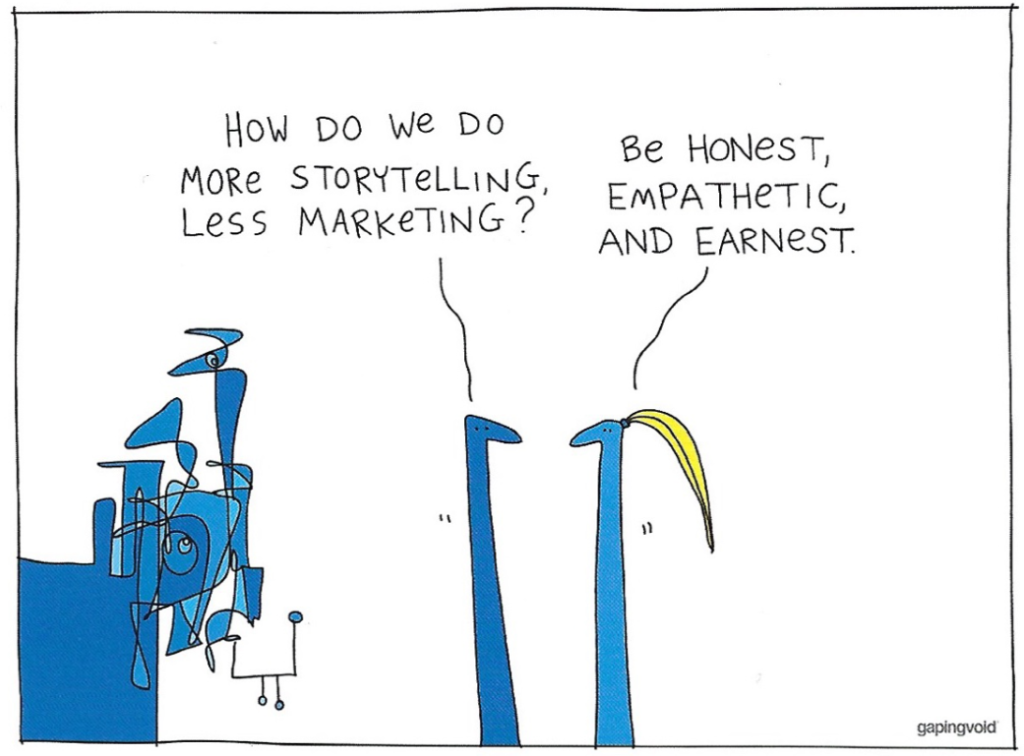
Illustration from, “Once Upon a Digital Time” by Gapingvoid and Brian Solis
Brian Solis
I always remember a quote from a very interesting, well-known advertising strategist, who was fond of saying to agencies and other marketers, “You’re not an effing storyteller!” This advertiser had read an interview with one of the most famous rollercoaster designers in the world, and this rollercoaster designer categorized his work as storytelling.
For the advertiser, this showed how easy it is for us to believe we’re storytellers, just because we produce content or we produce experiences. He was making the point that being a storyteller takes much more than just saying you’re a story teller. We keep saying it, not because it’s true, but because it feels good to say you’re storytelling instead of admitting you’re in marketing.
Personally, I think of storytelling as an aspirational title of sorts. I’m an optimist and so I want to believe that marketers do genuinely believe that they’re storytellers. What they need to consider though, is that this is a very sacred word. We’ve bought into the aspiration and the ideal of storytelling-based marketing, but we haven’t yet gone through the exercise of what it actually takes to become a storyteller.
I realized this several years ago when I was writing my book, X:The Experience When Business Meets Design. I was guilty of thinking that, because I was in control of the narrative, I was a storyteller. I wasn’t. My response was to find a storyboard artist to teach me the art and science of storytelling. That made a big difference, but I can tell you that even after going through that, I would never put storyteller in my title. It’s too sacred a term and we have to respect that.
You say in our book that marketers have ended up distracted by social media follower numbers, and lost their sense of purpose. How do you know when the purpose is missing? And how can you reclaim it through storytelling?
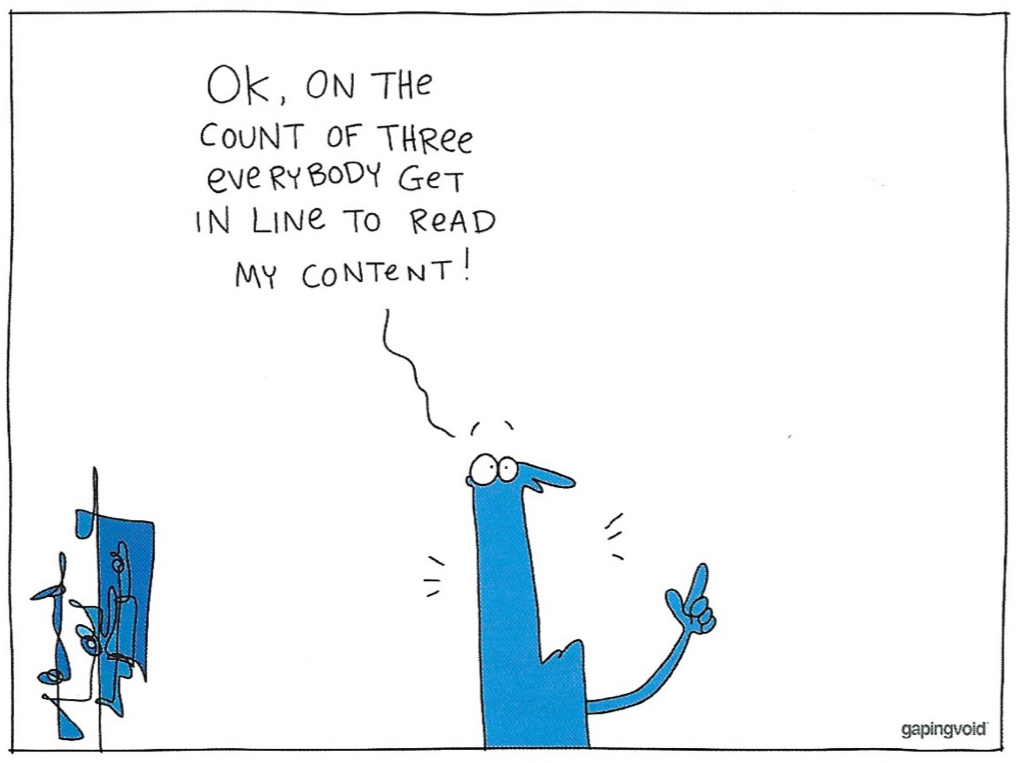
Illustration from, “Once Upon a Digital Time” by Gapingvoid and Brian Solis
Megan
You say in our book that marketers have ended up distracted by social media follower numbers, and lost their sense of purpose. How do you know when the purpose is missing? And how can you reclaim it through storytelling?
Brian
The challenge for marketing is that it’s adapting storytelling, it’s adapting social media, it’s adapting mobile, it’s adapting all of these new channels on the basis of a classical foundation of what market ing means. It has a traditional matrix that has to adapt to new times, technologies and trends. That matrix ends up focused on the wrong things.
It’s not that marketers don’t get it. It’s more that they’re packaging technology into a construct that they know. It’s self-reinforcing. Executives there fore see marketing in these terms, and fund it and support it in these terms. They’re supporting what marketing is, not what it could be.
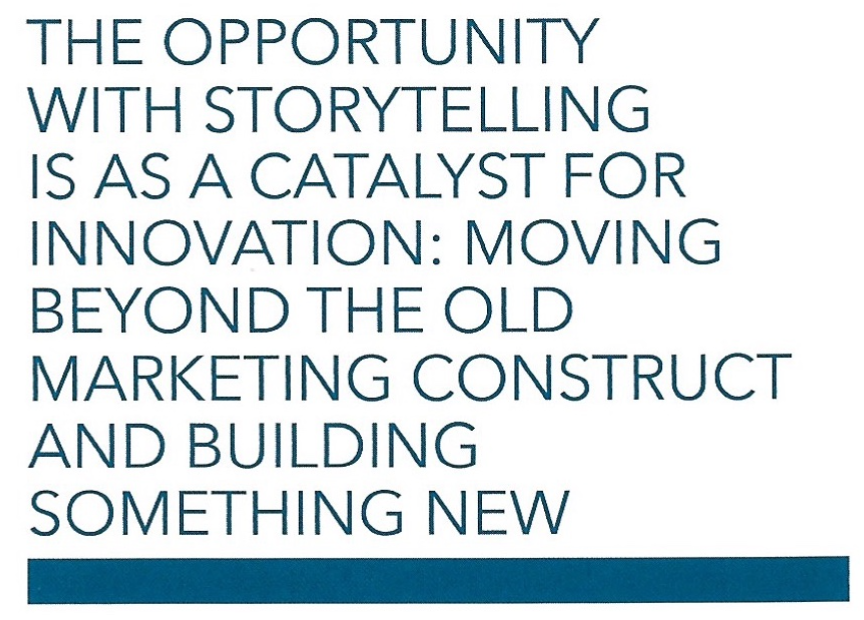
This is a time for reinvention and innovation. In the book, we talk about using storytelling not just as a guiding light for the future of engage ment and experience, but also as a catalyst to drive innovation. What does it take to tell a great story? What does it take to really understand your audience? What does it take to be really compelling? What does it take to move, guide and inspire them?
The answers to those questions are going to take some marketers out of that old construct and start them building something new: a new generation of marketing that’s less about ‘Marketing’ and more about experience and engagement.
This raises the question: once I have your attention and you have my attention, what are we going to do about it? When you start thinking in these terms, you’re stepping in a new direction, and you continue to step in new directions as you pursue these ideas. I call it ‘progressive transparency; moving beyond what marketing used to focus on and taking an interest in ‘The Embrace; or what happens when you engage.
The challenge that marketers have today is that their budgets, resourc es and expertise are all emblematic of how we viewed marketing yester day, not of how marketing needs to be tomorrow. We get caught up in these cycles of allowing marketing to be driven and guided by executives, who want to see certain things communicated in certain ways. I mean the fact that legal has such a strong voice in what we can say and what we can’t say, or what the narrative has to be according to the “optics of the organization”. These are all designed based on yesterday’s view of what marketing is, and this holds marketing back from what it could be.
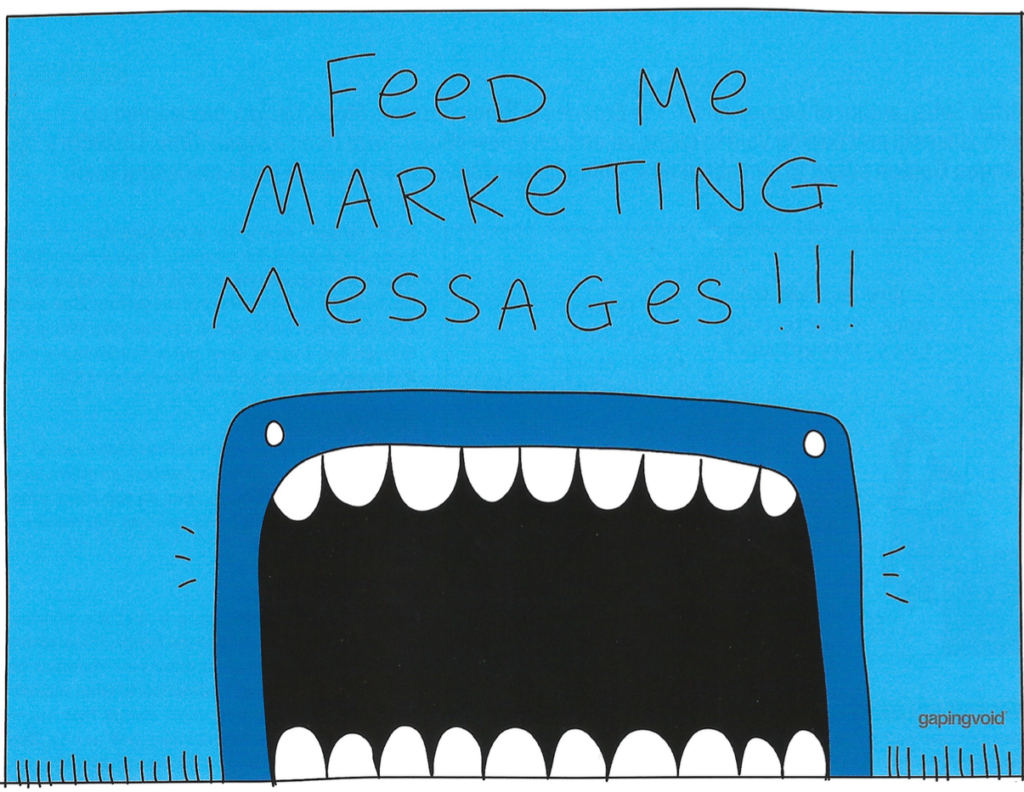
Illustration from, “Once Upon a Digital Time” by Gapingvoid and Brian Solis
Megan
How were you originally connected with Hugh MacLeod and what is it about Hugh’s illustrations that you feel really bring your words to light?
Brian
I was part of the startup community that eventually became Web 2.0 and then developed into social media. Hugh was also part of that group. He was coming from Savile Row and leaving the advertising world behind. He was using cartoons to expre& some of the really amazing things that technolo gy was starting to empower us with, and all of the paradoxes that it had introduced into our lives. He was also taking shots at the way marketing kept focusing just on the next advertisement. We orbit ed the same circles in the Web 2.0 world and in its earliest stage, that community wasn’t just about working. It was also about validation and self-help and support. We would meet for drinks and bring all of the entrepre neurs together to talk about what we were working on, and help us get everything to the next level. I just instantly bonded with Hugh. He’s a wonderful human being and so witty and clever.
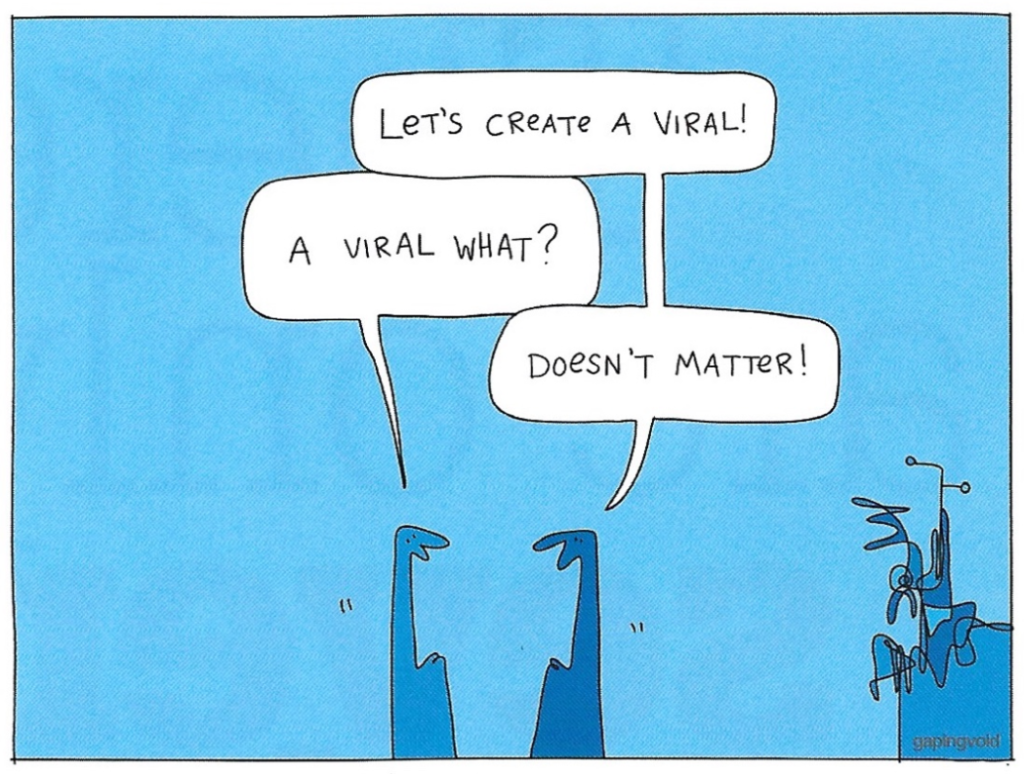
Illustration from, “Once Upon a Digital Time” by Gapingvoid and Brian Solis
Megan
You wrote a book a couple years ago, X: The Experience When Business Meets Design. In there you talked about the need for businesses to invest in experience architects. Can you explain how storytelling plays into the design of those experiences?
Brian
Once I got to the core of what an experience was, I realized that you can’t design experiences unless you’re intent on them. When someone comes into contact with your brand, your product, your service, your packaging or your representative, you don’t want them just feeling the value of those parts; you want them to feel more than the sum of those parts. You have to design the experience as a story where everything comes together into an arc that people will feel, walk away with, and talk about. So, it was very intentional way of looking at experiences. I think it was a little early as an idea, and now it’s starting to be appreciated a bit more.
So, the idea of becoming an experience archi tect is essentially not unlike becoming a storyteller. It’s about being able to build experiences by trans forming every aspect of a company around the experiences you want to deliver.
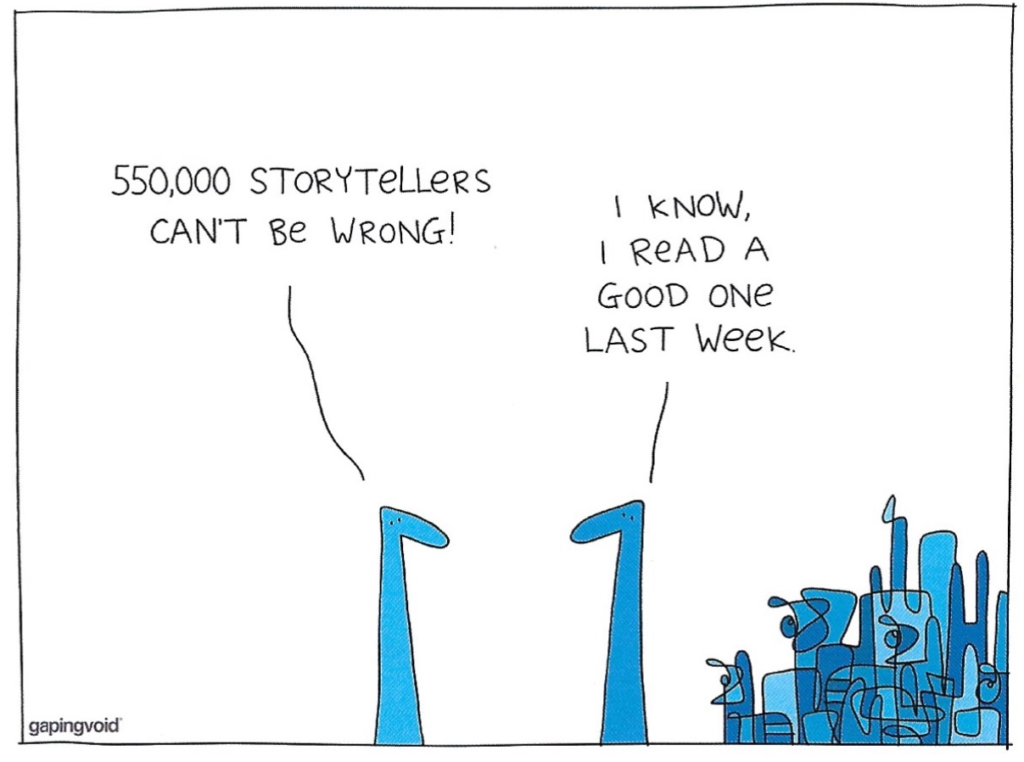
Illustration from, “Once Upon a Digital Time” by Gapingvoid and Brian Solis
The real challenge is that we approach all this acting like marketers. We talk like marketers. We measure like marketers. We talk at people based on what other people have approved us to say and none of it feels human. That has to change. The first step is realizing that we’re in denial. Then we can accept the need for change and start moving in a new direction.
“I love receiving generic emails and text messag es;’ said no-one ever. We have to understand that marketing is what it is. The reason it doesn’t have a seat at the table in most C-suite discussions is because it’s not aligned with business growth and it’s not aligned with customer experiences.
But it could be! Marketing doesn’t have to be a discipline or a function. It could become the work that customer experience teams are doing by using communication, touchpoints, technology and channels to deliver experiences holistically. I think marketing’s futures are bigger than we give them credit for because we’re still stuck looking at what marketing was rather than what it could be. The reason storytelling in marketing matters is because it starts to force us to move beyond that. When we accept it as the sacred term that it really is, it absolutely demands transformation. It’s not just another marketing tactic.
Lifescale
Explore Brian’s vision of storytelling in marketing along with Gapingvoid Culture Design Group by downloading “Once Upon a Digital Time” at lnkd.in/storyteller
So, Can Storytelling Save Marketing? Let’s Discuss
Did you know that over half a million marketers list storytelling in their profile on LinkedIn? Marketers have become obsessed with telling stories. As a result, has storytelling fallen into the bucket of marketing buzzwords — a bucket full of words like authentic and transparency? Words we use in our marketing jargon but don’t actually take seriously and put into action?
Tune in for our latest episode of Live with Marketers to hear from master storyteller & LinkedIn Influencer Brian Solis and learn:
- What storytelling really means for marketers
- How our discipline needs to evolve in order for storytelling to thrive
- How storytelling can make an honest impact on the way you engage with your audience
Original link


More Stories
Business Risk Management Strategies for Uncertain Times
Global Opportunities You Should Not Ignore
Business Innovation Ideas That Disrupt Industries